Gye Greene's Thoughts

Gye Greene's Thoughts (w/ apologies to The Smithereens and their similarly-titled album!)

Saturday, October 08, 2016

How to effectively discipline your kids

This morning, at the swimming pool where my sons have swimming lessons, I witnessed some darned ineffective parenting.  The dad's two children were messing about and being unruly, and the dad kept saying "Stop that.  I said, stop that.  I really mean it:  stop that."

There were no consequences to the kids' actions -- so the kids kept doing their ill behavior.

And I thought:  Dude!  You're just training your kids to ignore you...


Thus, this blog entry.

What follows is my 2c.  The following underpins what I do with my own children, and it seems to work:  we occasionally get compliments on how well-behaved our kids are, and my response is usually, "Thanks.  We work hard at it."


My approach is based a lot on "operant conditioning" -- if you remember that from Psych 101 (Wikipedia page?).  My below approach is not a lot different from other approaches that you'll see -- except that I don't charge $$$ to attend my seminar or enroll in my program.  ;)


Executive summary:

-Parenting is basically "training" your kids, through rewards and punishments.

-Being consistent, and giving the reward or punishment right away is a lot more important than the size of the punishment.

-If you let the kids get away with stuff, then you're training them to ignore your commands and ignore your rules.

-If you interrupt their bad behaviors with small but immediate "micro-punishments", then you're training them to not misbehave.

-During "normal" life, also compliment (a reward!) for all of their tiny good behaviors.

-When they do something wrong, give them a chance to make it right. 

-Parents aren't perfect -- but they are in charge!


Principles:

-All creatures learn from their behaviors.  They learn through trial and error.  (If they didn't learn, they would starve and/or get injured.)

-If a behavior is rewarded, then that behavior will be repeated.

-"Rewards" are the gaining of good things (which includes "feeling good" or "is fun").  But "Rewards" can also include "removing bad things (e.g. "Goofing around, to be less bored").

-"Punishments" are when you give the person a bad thing (e.g. pain, anger) -- but can also be the removal of a good thing (e.g. "No t.v. for a week").

-If a behavior causes distasteful things (e.g. punishment; pain; yucky taste), then that behavior will fade out over time.

-Learning patterns of behaviors (both good and bad) is cumulative:  it doesn't happen all at once.

-According to Psych research, rewards and punishments do not have to be large to change the behavior:  they just have to be "large enough" -- large enough to out-balance the other half (e.g. the punishment has to be bigger than the reward; the reward is bigger than the punishment).

-But!  The outcome to the behavior does have to be (1) fairly prompt or immediate, and (2) fairly consistent.

-Rewards are just as important as punishments -- and in fact work better, because a reward-based environment is happier than a punishment-based environment.


Some implications of the above are:

-You have to provide an environment for the child where the rules -- and the outcomes for following or disobeying the rules (and commands!) are clear and consistent.

-Since the size of the reward or punishment isn't the main component, you don't have to cause physical paint (e.g. spankings), yell, or use extreme punishments (e.g. "No t.v. for a month!!!").  All you need is something to "interrupt the flow" (if the kid is goofing around) or neutralize the "rewarding thing" that the kid experienced.

-(Personal insight:  With my first child, I once slapped her hand when she was reaching for something she wasn't supposed to.  She looked at me and said, "Daddy -- you hurt me!"  And I realized that I couldn't think of any misbehavior that my children could do that deserved me to intentionally cause them pain.  And that's when I decided that there was no point in spankings:  there were other approaches that didn't involve hurting my kids.)

-However, the immediacy and consistency with the kids is crucialI personally don't believe in the "three strikes" approach -- because you're training your kids to ignore what you say the first two times!  (And:  that they can do bad things twice -- for "free"!)

-Bad example #1:  "Johnny, put the cat down.  Johnny, I said to put the cat down.  Johnny -- put the cat down!  Okay:  punishment."

-Bad example #2:  Susie hits brother.  "Don't hit your brother."  (Pause in behavior.)  Susie hits brother.  "Don't hit your brother."  (Pause in behavior.) 

-Another problem with the "Three strikes" approach is that if the gap between misbehaviors is too long, then it's hard to tell when "Strike #1" occurred.  So the kids just intermittently misbehaves (e.g. hitting her brother) -- and gets used to it!


-Because the "size" of the punishment isn't the key, you don't gain any effectiveness by yelling.  So try not to.  (Yeah, I sometimes do.  But I try to avoid it.) 

-It's good for the parent to say "please" when "asking" (telling!) the kid to do something:  it models polite interaction styles; and it's the follow-through that

-As a parent, try really hard to give the kid lots of praise as well:  because "doing the right thing" is so often a "non-event" that it passes unnoticed.  So compliment (or thank) the kid on washing her hands before meals (without being asked), throwing his socks in the laundry basket, etc.

-And if you ask the kid to do something (e.g. feed the dog), and the answer is (legitimately) "I already did it", then that deserves a "Ah!  Good job; thanks!"


My specific approach:

-I've tried a few things over the years, but it's finally ended up as:

-If it's a "permanent, obvious" rule (e.g. need to ask a parent before getting candy; no hitting), then there are no "warnings" -- because the kid already knew.

-If it was a genuine accident, then there's no "punishment" -- although if the kid was being obviously foolish or reckless, then there might be a punishment.  And the kid has to "un-do" the harm (see below).

-My "go-to" punishment is to have the kid stand up, go to the nearest wall and face it, while I slowly count to twelve.  (There's no magic in "twelve":  it just seems like the right amount of elapsed time to "break the flow", cause an inconvenience, and remove the kid from whatever behavior was happening.)

-However, the angrier I am, the longer the number.  But I try not to go beyond about a minute ("sixty") -- because then **I** get bored!

-After the "twelve-count", the kid then has to apologize (and give a hug?) to the sibling or parent that was harmed.

-"Facing a wall" works really well in public -- because there's nearly always a wall (or a pillar; or a table) to face.  I suppose if you were in the middle of an open field, you could have the kid stop and put her hands over her face.

-If there was damage to property, or a loss of property (e.g. ate a sibling's candy bar; broke a lamp), then I invoke a version of "restorative justice" (Google it?).  Basically, I'm trying to (1) neutralize the damage; (2) restore the social bonds; and (3) restore the self-esteem of the offender.

-For "Neutralizing the damage", I have the kid pay from her allowance, or do work around the house for pre-stated "$X/hour" to buy a replacement, hire a glass-repair person, or whatever.  If the labor is something that a kid can do (e.g. paint over graffiti), then I have the kid do that as well.

-Note:  When I was growing up, my parents were really good at figuring out very "fair" and "just" things for punishments. 

-For "Restoring social bonds", I have the kids apologize, and hug (we're a very huggy family).  Some families might want both parties to be able to share their side of the story -- but in our family everyone is so talkative (and the kids are loud!) that the whole backstory is immediately out on the table.

-For "Restoring the self-esteem", by allowing the kid to -- as well as possible -- undoing the damage that she or he causes, it teaches her/him responsibility, and gives them a self-concept of a good, responsible person that sees things through, corrects their own mistakes, and etc. 

-I try to give out all sorts of positive reinforcement, all day:  both "generic" ones ("I love you very much"; "You know, yer a great kid..."), as well as more behavior-specific ones ("Thanks for remembering to feed the dog, without my having to remind you.  Good job."; "Hey, I noticed that you're getting your laundry into the laundry basket.  Good job.")


Ownership and training:

-Another implication is that if you "clean up their messes" for them, then you're just training them to leave things around.  It's easier (less work!) to just leave your jacket on the sofa, your dirty plate on the coffee table, your shoes in the hallway.

-So, if you clean up after them (either quietly -- or even complaining about it!), then it's still easier for them to leave a mess -- because someone else will clean it up.

-Whereas, if you say "Hey -- could you please put down you book and come put your jacket away?" -- the kid will say "Awww -- that's a pain..."  And you'll say, deadpan:  "Yes.  Exactly."  And hopefully -- after enough repetitions -- she'll just figure out that it's faster and easier to just hang up the jacket in the first place.
  
-Plus the kids learns to be responsible and self-sufficient, and to not cause problems for others.

-I'm trying to teach my kids:  "Don't cause more work for others:  other people have enough of their own work to do, without doing yours."  And that there's no shame in asking for help -- but only if you've honestly tried to do it yourself, first.

-In other words:  don't be a PITA to others; you don't want to be that person (at work; among your friends...).


An additional part of my approach:

-I don't believe in trying to pretend that "the parents are always right":  because we're not.  Sometime we don't have the full information -- or we're just plain wrong.
 
-But!  The parents are (1) the ones in charge, and (2) the ones responsible. 

-Note:  I think the above two points are true of any leadership situation:  e.g. your boss at work; the CEO.

-This means that when I tell the kids to go do something, they get one rebuttal.  (e.g. "Okay!  Time to put your shoes on and go to the car!"  "Oh -- but Mom texted and said that we don't need to leave for another half hour."  "Ah.  Did not know that.  (But why didn't anyone tell me before...?)"

-Another example:  "Could you come and set the table, please?"  "Oh -- but my YouTube video only has two minutes left -- I really want to finish it...!!!"  "Okay -- but directly after that video...!"

-But they don't get to have a whole list of attempts to "argue the way out of it". They have to pick their best rebuttal.  (Well, okay -- sometimes two.  But not a whole list of attempts.)

-As another few parts of being imperfect:  if I accidentally, un-justly punish a child -- it's less bad if the punishment was "12 seconds facing the wall" than "inflicting pain (a spanking)".  And I apologize.

-Also, if I'm wrong, I apologize to the kids.

-Also, if I lose my temper, I apologize, and point out that yelling wasn't the right way to do things -- but that I'm spending my whole life trying to get better.

-I think that those things (being imperfect; admitting my mistakes; taking responsibility; making things better) are also important role-modelling.  I don't want to have arrogant kids that think that they're perfect and can do no wrong, never apologize, and never admit their mistakes. 


Finally:

-This approach should work with special needs children, such as those with developmentally disabilities or ADHD.  There's no reason why it shouldn't work:  if your children know to head towards the bathroom when they have to pee, and head to the kitchen when they're hungry -- then they're capable of learning.

-But, yes -- I suspect that it would be more difficult, and take more repetitions, with someone that has learning difficulties.

-Yeah, sometimes I screw up with my parenting.  I do not think that I'm sort sort of perfect parent.  (e.g. we typically leave the house in the morning in a mad rush; I don't read them bedtime stories like I always thought I would; I let them spend too much time watching YouTube videos.)

-Someday I may re-visit the above, and change some of the phrasing.  But for right now, I just wanted to get my thoughts out.


--GG

Labels: , , ,

Friday, November 27, 2015

Now left-dominant

As you know, I'm pretty much right-handed (with hints of amidextrousness), but had my right arm in a sling.

I've been out of my sling since Monday, and spent most of the weekend preceding out of the sling as well -- so, this is essentially my seventh day sling-less.


Curiously, my five weeks in a sling have made me left-hand dominant. Although I still instinctively use my right hand for writing, scissors, and knife work in the kitchen, everything else is reflexively left-handed: scratching my nose, opening doors, turning on faucets, brushing my teeth...

Since abandoning my sling, I've returned my cell phone "belt pouch" to my right hip -- which means I now take the phone out of the pouch, hold in in my right hand, and use my left hand to text.

Likewise, I've returned my public transportation "swipe card" to my right pocket: when I get to the train station I take it out with my right hand, hand it to my left, "swipe" with my left, then hand it back to my right hand to put it away.

When I get jugs of milk or juice out of the 'fridge -- if the jug is on the left, I'll pour with my left; if the jug is on the right, I'll pour with my right.

Even with writing, I've experienced a partial shift to my left hand: I tend to underline phrases in magazines and take note of the page number. Since removing the sling, about one-third of the time I've used my left hand for underlining and noting page numbers (i.e. writing the number on the magazine cover). Written notes (actual words), however, tend to be done with my right hand.


I'm curious to see how long -- if ever -- this behavior persists. It's probably self-reinforcing: the more times I do a task with my left hand, the more "normal" it seems to my system.


--GG

Labels: , ,

Saturday, November 14, 2015

Instant personality test

When you are at a shop (e.g. Target, K-Mart), you go to the customer service counter, and the sales clerk says, "Hi!  How are you?", do you:

A.  Go straight into your question or issue that brought you to the customer service counter.

B.  Reply, "Fine, thanks", and then ask your question.

C.  Reply, "Fine, thanks.  How are you?"  And then ask your question.


--GG

Labels: , ,

Thursday, November 05, 2015

Rewritng my neural pathways

I'm right-handed, and I've had my R. arm in a sling for the last two and a half weeks, so my R. arm has been fairly inactive (although I sometimes use my R. hand for holding very lightweight things).  So almost everything I've done for the last three weeks -- opening packages, writing by hand, folding laundry, eating with a spoon -- I've done with my left hand.

A few evenings ago, I finished brushing my teeth -- and realized that I hadn't been paying attention to the process:  I had simply "brushed my teeth" without thinking!
 
And today at work, on a whim, I grabbed two pencils and used them as chopsticks, with my left hand, to pick up various small items.  No trouble whatsoever.
 
So, even though I haven't actively practiced chopsticks with my left hand, my daily use of my left hand for other tasks has generalized to a greater over-all left-hand dexterity than before.
 
I've always been somewhat ambidextrous -- but still clearly R-hand dominant.  So this is both interesting and neat-o.
 
 
--GG

Labels: , ,

Saturday, July 25, 2015

Imperfections


===================================

“We are all a little bit broken.”


--Gye Greene, July 25, 2015

===================================


Labels: , ,

Sunday, May 31, 2015

Faces on trains

There's a psych concept called "pareidolia" (I remembered the concept, but had to Google the name), which is the human tendency to perceive patterns in random stimuli.  For example, seeing shapes in clouds, or seeing faces in objects (the Virigin Mary on slices of burnt toast).

At left is the red emergency door-opening button on the commuter train.  I hadn't noticed the face-like characteristics until I was sitting at the correct angle.

The "stick figure" doodling just emphasizes the point.


--GG

Labels:

Wednesday, May 20, 2015

Neat-o psych effect

Found this while looking for something else.  It's a Psychology thing, called the Dunning-Kruger effect.

Basically, people who aren't very skilled at something over-estimate how good they are (relative to other people), because they don't understand the activity enough to know how much they suck.

Meanwhile, people who are skilled tend to under-estimate their abilities -- because they think that other people find the task as easy as they do.  (And, I would say, because their greater understanding allows them to better see the gap between what they are doing, and how it should be.)


--GG

Labels:

Thursday, January 09, 2014

Value

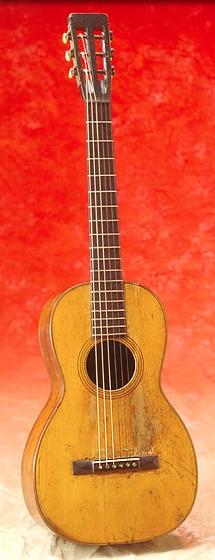
Someone on the woodworking list that I belong to posted this link to Mark Twain's acoustic guitar (really!).  It's valued at over fifteen **million** dollars.


Some people on the list queried this extreme value.  "Mike in Sacto" posted the response, "My first thought was, 'Well, it belonged to [Mark] Twain.' "


He also posted the following (I've altered the formatting):

My second thought was, "Because somebody wanted it badly enough to pay
that price.  


More years ago than I care to think about, a fellow was trying to sell a pre-Columbian artefact for $500.  A potential buyer asked, "Is it worth $500?"  The fellow answered, "It is if you will pay $500."  

There's a lot of truth in that answer.


Ayep.  :)


--GG

Labels: ,

Friday, March 02, 2012

A difficult task

I was leaving a comment on a blog, and one of those word verification things asked me to type in some scribble-looking words, with the instructions ''Please prove that you're not a robot''.

Prove that I'm not a robot? **That's** a bit of an ask!

And just typing in some words doesn't prove I'm a robot: maybe it proves I'm a really smart robot!


--GG

Labels: , ,

Saturday, January 28, 2012

More operant conditioning

The hotel where I stayed, the night before my flight back home, has those new-fangled door locks that are unlocked by swiping a plastic card.

Whenever I'd get to my room, I'd instinctively grab at my right hip -- which is where my swipey card dangles... when I'm at work.

Operant conditioning. Interesting.


--GG

Labels: ,

Thursday, October 06, 2011

Illusion of pricing

I'm in Australia. Almost bought a guitar effects pedal (an octave pedal) thru Amazon.com. Pedal was about thirty bucks -- but turns out that international shipping and handling was **also** about thirty bucks. Pah! Not gonna pay as much for shipping as for the pedal.

Funny thing, though: If the pedal had been fifty bucks, I probably would've still thought that was a fair price for the pedal. And if the shipping had been ten bucks, I would've thought that reasonable.

So, still sixty bucks, total. And yet one transaction gets rejected, while another one would be approved.

It's all how you slice it.


--GG

Labels: ,

Monday, November 22, 2010

Experiment

In our household, we've tended to color-code things for our (fraternal) twin boys: Eric gets green things (shirts, socks, plates, cups, toy cars...) and Nathan gets blue things.

Because of this, for the last month or two, both E and N will point to things of that color and identify it as "My [name of item]!" or "[Name of other boy]'s [name of item]!" For example, if we're in a parking lot and see a green car, Eric will point to it and declare "My car!"

We've also -- for our own reference as well as theirs -- marked their items with an "E" or an "N". And thus for the last month or two, they've also (correctly!) identified items based on those letters -- to the extent that over the last half-month when they see an "E" or an "N" as part of a store sign (e.g. "SAFEWAY"), they'll point to that letter and declare "Eric!" or "Nathan!"


But -- I was curious as to whether the color, or the letter, had priority: how would they respond when presented them with a letter that was the "opposite" color -- i.e., a blue "E" or a green "N"?


For the first run-through, I presented the blue "E", then the green "N", and followed them up with a blue, then green, capital "Delta" (basically, a hollow triangle). Both both boys prioritized the letter over the color, declaring the blue "E" to be Eric's and the green "N" to be Nathan's. Thus, language appears to trump the color-coding.


For the second run-through (performed on the following day), I wanted to see if being "primed" with the color assigned to a neutral geometric shape (the delta-triangle, again) would increase the importance of the color, rather than the letter. So, this time I showed the blue, then green delta (both boys assigned the color to the correct person), and **then** did the blue "E" and the green "N".

Nathan prioritized the letter over the color -- despite having been first shown the blue triangle. Eric, however, said "Nathan" (rather than "Eric"!) for the blue "E" -- and then said "Nathan" again for the green "N". However, when I then returned to the blue "E", on that second try he said "Eric". This suggests that the meaningfulness of the shape, as opposed to the color, is not quite as firmly embedded in Eric: Nathan's prioritization of the letter over the color persisted despite being "primed" with the color-only stimulus, whereas Eric's prioritization was shifted by it.


I should note that the letters were centered on a folded-over piece of typing paper, and each was about half the width and length of that folded-over paper. Also, the thickness of the letters, and the Delta, was about as wide as my pinky finger (a little under a half inch), so the color was fairly apparent.

Also, each boy was presented with the stimuli in isolation from the other boy.


--GG

Labels: , ,

Thursday, May 20, 2010

Moving in versus moving out

It's interesting to me that you can tell at a glance whether someone is moving in to a place, or moving out.

My folks are visiting in a few days, so we’re trying to vacate out old home office to give them somewhere to sleep. The computers, desks, and filing cabinets are all going off to another room -- the new home office.

I think we perceive whether a room in getting packed up, or moved in to, by what’s still there: when moving in, people start with the furniture; then set up the larger fixtures (computers, lamps); and finally unpack the small stuff. The contents of half-emptied boxes will look fairly compact. The room itself lacks miscellania.

In contrast, when moving out, a lot of the big stuff (furniture) and medium-sized stuff (computers) will have gone. So you end up with a lot of miscellaneous and unsorted cruft: coathangers, scraps of paper, shoeboxes of pens and pencils.

I’ll let you take a guess as to which end of the process these photos represent.


--GG

Labels:

Wednesday, May 12, 2010

Still have American mindset

I've lived in Australia for eight years -- but lived in the U.S. for thirty years before that. So apparently, sometimes I still think like an American.

Yesterday we received someone else's letter in our mailbox: we're 845, but the letter was for 745.

''Just the next block'', I thought. ''I'll pop out and deliver it.'' Although we're semi-rural, I figured it would just be the next block over -- even thought ''the next block'' would be several houses along. A quick little walk.

I got about three houses down before I remembered that I had it wrong. Our house is at the far end of a fairly long road: 5 kilometers (about 3 miles). And it's not numbered like the American system, where every block = 100 (e.g., the 700 block, 800 block, 900 block). Instead, I'd be walking seven-eighths of 5km -- round-trip!

Two and a half miles -- each way! -- is hardly ''a quick little walk''. I think I'll use the car.

Addendum (5/12/10): Duh! Actualy 1/8 of 5km, NOT 7/8! So, 3/8 of a mile, or 5/8 of a kilometer each way; 3/4 of a mile (about 1 1/2 kilometer) if going round trip. Not **that** bad. But still more than just "two houses down".


--GG

Labels: ,

Monday, May 10, 2010

Two about The Girl

Sunday -- yesterday -- was our usual library day. Here's two things I noticed about my daughter.

1) She called the hands of the clock “handles”. Makes sense – they’re shaped more like handles than like hands.

2) On our way out, the library guy had gave each of the kids a sticker on the back of the hand. However, by the time we got out to the hall, B1 had lost his, and was clearly sad about it. The Girl (unbidded) peeled hers off the back of her hand and put it on his -- which was **very** kind of her. (I was proud.)


I logged both of these in the ''developmental'' notes I keep on each of the kids (e.g. language development, social awareness, motor coordination, etc.)


--GG

Labels: ,