Gye Greene's Thoughts

Gye Greene's Thoughts (w/ apologies to The Smithereens and their similarly-titled album!)

Tuesday, March 12, 2019

Day 4 of vacation -- Tuesday

So, it's Tuesday:  day #4 of my vacation.  (Oh:  never got around to playing my effects pedal last night:  got trapped by the internet instead.)


The other car is in the shop, so I'm stuck at home. That's fine:  plenty to do.


Helped everyone (except me) get out of the house:  made sandwiches and cut up apples for the kids' lunches (they assemble the rest).


Puttered around a little bit; maybe put some laundry on (I forget).  Took a nap from about 9:30 to 12:15pm.  Kind of "burning daylight" (i.e. should've been getting things done outdoors) -- but it was a fairly hot day -- and I enjoyed the nap very much -- so:  eh. 


Had a breakfast-lunch of two bowls of cold cereal while watching a half hour of the Netflix series Dark Mirror:  pretty good -- although I'm appreciating some episodes more than others.


Loaded the dishwasher and started it.  Did some laundry. 


Pretty humid:  some rain during the day. 


Another 15 minutes or so of Dark Mirror.  Finally got changed and went outside at 1:45.


Spent my time splitting the sections of palm tree that I cut down a few days ago.  Took me longer than I expected:  some species split easily; some don't; this one is in the middle of the range. 

Ran out of wedges, and my existing gluts (like wedges, but made out of wood; user-made; expendable) weren't thick enough, so I made some more.  That took me until near dark.


Borrowed the riding mower from my brother-in-law:  tidied a few places in the lawn (mostly the "soccer field" -- currently set up with two poles and a rope, to mimic a volleyball net).  Kept it overnight, to use tomorrow.


Packed up my tools around 6:30m; went inside; showered.


Decanted the remainder of expired food into a big bucket, and stashed it far away from the house:  didn't feel like trekking it down to the existing pile; stashed it far enough that vermin wouldn't be attracted to the house; will shift it tomorrow.


Made dinner for the boys and me (The Lady and The Girl were away at a sports thing).  Just sandwiches and cut apples:  usually we'd have frozen pizza, but for some reason The Lady didn't pick any up when she did the weekend shop. 


The Lady got home; chat with The Lady. 


At 8:30pm, watched some more Black Mirror (which drinking loads of water), then do laundry; more chatting with The Lady.


About 10:30pm actually plugged in the delay pedal and had a go (using a guitar wiith single-coil pickups).  Pleased with my choice of pedals:  the "digital" sounding echo rather than the "analog" (i.e. high-end fades with each repeat) that I chose to not get. 

Messed around with various riffs, chords, and some of the very few actual songs that I can play the melodies (e.g. "What Child is This"/"Greensleeves").  Came up with a chord progression that could make a song:  can hear it being doubled, with a different strum pattern, on acoustic guitar.  Still need a chorus section, and a vocal line (melody) for both -- and lyrics, of course.


Bed around midnight:  I'm nocturnal -- and I don't have to work tomorrow. 


--GG

Labels: , , ,

Wednesday, August 22, 2018

Wood stashes

Similar to a quilter who has boxes of interesting scraps of fabric all over the house, I have stashes of wood for future projects.  Some of them have been around for a number of years -- out in the weather:  one of my "To Do" projects is to make a shelter for them.  But, by accident, I've learned that wood lasts a really long time "out in the weather" -- as long as its not lying in the dirt, and it has a chance to dry out again.


This is the pile of wood that inspired this blog entry:  I was selling something on Gumtree (the AU analog of Craigslist), and the buyer asked whether this was some sort of sculpture.

Nope:  just some chunks of wood, held up by some empty, inverted plastic pots.  I split the wood before it dries, so that the wood has "somewhere to go" when it shrinks as it dries.  And I paint the ends to try to minimize moisture loss from the ends (again, to minimize splitting and end-checking).

The rubber boot is there as a size reference:  I'm taking the photo with one boot and one stocking foot. 


The photo is dark, because it's inside my chicken coop! -- but here's a sash of 50+ year old beams that I've found around my property.  Been lying in the dirt (or, when it rains:  mud) for decades -- but only the surface was eaten away:  the core is good.  Hardwood; reddish color:  when slabbed it'll make some nice-looking lumber.
Would consider leaving some surfaces "weathered", and other surfaces smooth and oiled and pinky-red.


These are quartered "small logs", I guess you'd call them?  It's on a metal rack (a table, minus the top?).  Gonna make it into a rustic table:  it'll be an experiment to see if I can do the minimum amount of processing, and in particular, no slabbing.  Instead, the ends will be "tongued", to fit into grooves in the simple rails, and the legs will be tenoned into the bottoms of the rails.  I'll handplane the upper surface of the tabletop, but there's no need to plane (or even shape) the underside.  You'll see (eventually).
I think it's some sort of eucalyptus, but I'm not sure.  I wrote it down on the underside of some of them -- but I couldn't be bothered un-stacking the pile to see.


This isn't "finally", as I have other stashes -- including under the eaves (back of the house), and on the (fairly long) front porch.  Anyhow:  a cedar-looking wood (except it isn't).  A boot again, as a size reference.  No specific plans or vision:  maybe a rustic bench? 


Brother:  next time you visit, you can make something, if you like.  And/or take a sample home with you. 


--GG

Labels: , ,

Thursday, December 29, 2016

The robustness of old wood

Back in late June of 2015, my church cut off substantial portions a major section of a leopard tree on the church grounds.

I grabbed a few of the larger pieces -- but because I didn't have time to slab them (by hand!) at the time, I put them in my kids' wading pool and filled it with water.

And now, late December of 2016 -- so, literally a year and a half later -- I finally slabbed the last one!


I had them soaking in water to "stop the clock" and this gave me time to slab 'em: I have a one person crosscut saw that I re-filed to rip -- but it still takes me about a half hour per slice to slab them.

I was pleased that none of them rotted. **No** splitting or checking occurred in the interim.


Here's a snapshot of the yechy-looking outside (blue garden hose for size reference)...


and the purty-looking inside (after a few swipes of sandpaper and a quick rub of oil).


Note that I scrubbed off the "pond gunk" with a wire brush prior to sawing -- leaned the log up against something for a few hours to dry, prior to sawing.


I'm just offering this experience as a data point for anyone who has a chunk of wood that they want to "put on hold" for a while.

If you don't have a wading pool, I presume an old ice chest, a dis-used garbage can, and etc. would also work.


--GG

Labels: ,

Wednesday, December 14, 2016

Wood on my desk

The Lady got back from a conference in Tasmania a week or two ago.  During her visit, she browsed through the local flea market and picked up some offcuts from a guy with a "wooden things" stand (I think he made cutting boards).

I sanded them smooth, oiled them, and brought them in to work.  I keep them on my desk, partly to remind me of how much I enjoy woodworking (and nice wood), and partly to remind me of the considerate nature of The Lady.


--GG

Labels: , ,

Saturday, October 08, 2016

Missed a scavenge

Saw this as I was leaving the local shopping mall:  two wooden "vegetable displays" in the bins.  The wood for the legs is pretty hefty:  enough "meat" that I could do something with it.

And the display stands themselves -- presumably surplus from the produce store -- could probably be put to work as some sort of gardening stand (for potted plants), or some sort of work surface.

Sadly, I have no way of getting them home.  If only I had a pickup truck, or a small trailer.


--GG

Labels: ,

Thursday, November 12, 2015

Thoughtful son

Today my youngest son (B2) brought home an unusually-shaped chunk of wood from school, because he knows that I enjoy pieces of wood.  I think he got it from the gardens or landscaping that's near the playground.

I'm showing two different views, here.  It is a peculiar shape:  it's hard to represent it by photographs.

Very thoughtful of him to get it for me.  :)


--GG

Labels: , ,

Friday, July 17, 2015

Save that lantana

In England, lantana is a lovely hedging plant with pretty flowers.  But in Australia, lantana is a weed -- a noxious pest that spreads everywhere (and when you throw fresh branches on the ground, the buds take root and grow new bushes!).

A few weeks ago I had cut down a few lantanas and piled them up (suspended above the ground, so that they wouldn't take root) to deal with later.  But recently I cleaned up my mess a little, and cut the main trunk into lengths that I could eventually burn.

The main trunk is about as big around as my wrist.  As I was cutting it into lengths, I realized that it actually has a pretty nice color!  So, I saved the two larger-diameter pieces.

Here's the first photo, which is kind of an optical illusion:  to me, it looks firewood-sized.  (Note that I oiled the wood, to make the color and the grain look more like what a finished project would look like.)


But, here's the same pieces with my thumb as a size reference.  Pretty small.  Barely usable.


But, "barely usable" is usable nonetheless.  I'll make a very small box out of this -- one of these days.


--GG


Labels: ,

Sunday, April 19, 2015

Two short logs

Two weekends ago, while doing my pathetically short jog, I came across some short lengths of small-diameter logs by the side of the road.  I recognized them as wattle, which has a lovely reddish-brown color, so I came back a few days later and picked up the two larger ones.

I knew I wanted to use the wattle wood in projects.  But:  if you let logs dry "in the round", you get a lot of splitting -- which reduces the amount of usable lumber you end up with.  So I've found that you need to split them into quarters or eighths (depending on the diameter of the log), or cut the log into slabs.

I knew from experience that wattle doesn't split cleanly, so I would therefore have to saw them into slabs by hand.  I also knew that I wouldn't have time to do that right away, so I put them in my children's plastic wading pool (which was already filled with rainwater), to prevent them from drying out and cracking -- which ruins the wood for woodworking.


And then, this recent Thursday, on my way to the train station, I passed by a house where some workers were tossing branches into a grinder, which blew the chips into the back of the truck.  To the side of the house, on the grass, were about ten log segments from the trunk of the tree.  I stopped to inspect them.

The woman who lived in the house -- I presume -- came out to see what I was doing, and I told her that I do woodworking, and could I please save two of the logs?  She said OK, so I rolled two of them to the side, and she told the workers to **not** load those two onto the truck.

She said that they were fiddlewood.  A friend told me that it's basically a week here in Queensland.

That evening after work, I stopped by and threw the -- fairly heavy! -- log segments into the trunk


So, the wattle first.

I spent part of Friday (home with a sick child) and part of Saturday hand-sawing them.

By the time I got to the point of photographing them, it was getting near dark.  Since I wanted to get my blog entry posted, rather than wait another day, I set up two lights.  The yellow light is a halogen(?) work light -- which is very bright, but kind of yellow-y.  The green light is a solar-powered one from Ikea, which provides a bluer light.


Here's one of the pieces.  You can see that it has a fork, which makes for an interesting grain pattern.  I took a scrub plane to this one, to clean it up a bit, and also rubbed some Danish oil on it to bring out the grain.  However, the oil is still wet, which makes the wood look a little slimy.  Ah well.
(You may want to click the photo to enlarge it.)


This one is from the other small log.  This one is neither planed nor oiled -- but you can still get the sense that it's some nice-looking wood.  Both this and the previous piece are about 10cm by 35cm (4 inches by 14 inches).  That's enough to do something with.

And, here's the resulting stash.  I'll end up making some sort of small-to-medium storage box or jewelry chest, after I let the wood season for a year or two.


And, the fiddlebark.

Here's a shot of the two logs, as I dumped them in my front yard.  They probably weighed about 60-70kg each (130-155 lbs.) when I lifted them into the car (wet wood, freshly cut):  they felt like they weighed nearly as much as me, but not quite.


Here's one of them, with a ruler on it.  Both of them were almost exactly the same length and diameter, so there's little point in showing both of them with a ruler.  The ruler is 12 inches (about 30cm) -- just to give you a sense of scale.


These were of a decent diameter, so I was hoping to heck that they would split cleanly:  splitting is a lot faster and easier than hand-ripping with a saw.  (I refuse to use a chainsaw:  too dangerous.)  I'd never used fiddlebark, so I didn't know what to expect as I began to split the first log...


But!  Here's one of the logs, after I'd split it with some wedges.  It split fairly cleanly:  note the straightness of the split, where I've indicated with the red rectangle.  However, it does get a little ragged further down:  see the blue rectangle.


Here's a shot of the wood in the process of being split.  That's a wedge from my paternal grandfather's estate, BTW.  In fact, most of the wedges I used for this wood-harvesting are from his estate.


Here's a shot of one of the original logs.  As you can see, it's pretty much 12 inches (30cm) across:  that's enough to do some useful things with it.


Once I did all my splitting -- here's a shot of a portion that I cleaned up with a scrub plane -- the area is indicated by the red rectangle -- and then rubbed with Danish oil to show the figure.  This piece of wood is flatsawn.  I'm a little disappointed with the color:  when I was examining the logs when they were on the woman's lawn, I thought the wood would have more of a pink-ish coloring.  Still, not bad -- and the figure is usable.  (Click to enlarge, if you like.)


Here's another piece -- again, cleaned up with a scrub plane, as indicated by the red rectangle.  This one is quartersawn.  It also has some spalting, which gives it some variation in color.  (Again, click to enlarge.)


I have two pieces like this:  about 30cm by 50cm (12 inches by 20 inches) -- enough to make a seat of a simple stool.


Here's an indicator of the thickness.  Should make a good seat for a stool...


And, here's the resulting stash (oops!  getting dark...).  Enough to make a six-board chest (or two?) (explained below), plus a simple stool or two.


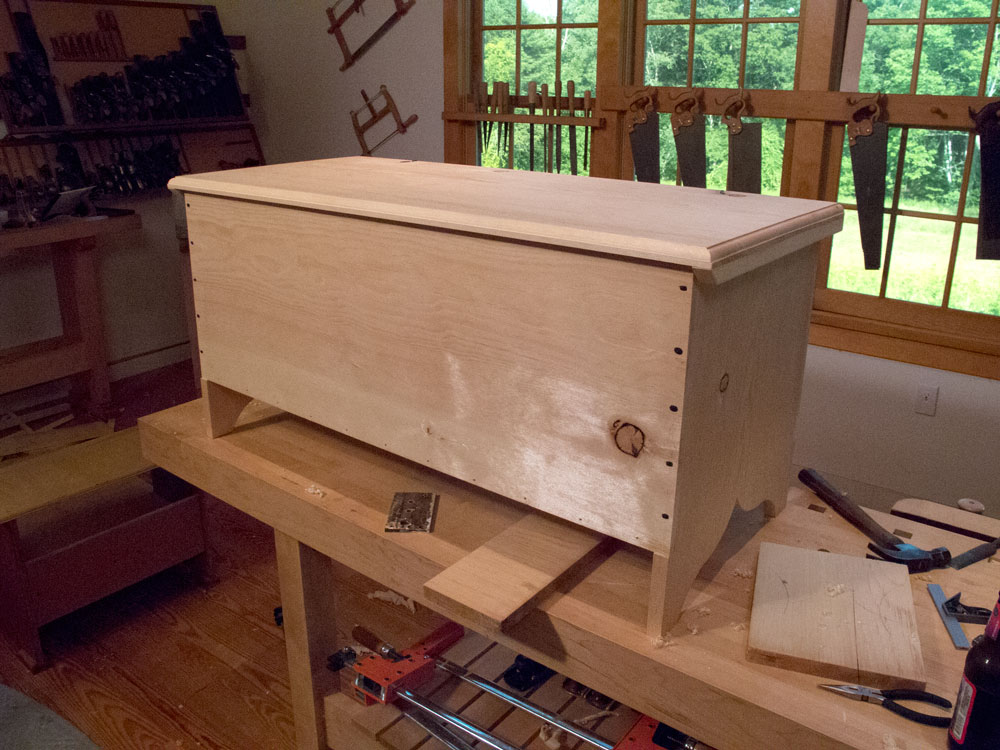
Here's what I'm thinking of, when I say a "six-board chest":

Basically, you get six wide boards, and join them together to make a storage chest.


And, here's what I'm thinking of for my eventual footstools.

This first photo shows two footstools made by my late (paternal) grandfather; I'm thinking of emulating the one on the right.


Here's another example.  I'd probably splay the legs like this one, in contrast to my grandfather's design (above), where the legs go straight down.


However, for security (i.e. robust engineering), I'd probably have the legs go all the way through the top, then "wedge" the legs (with the force going against, rather than across the grain -- of course).


For all of these slabs of wood, I'll let them season "loose", on shelves, rather than "stacked and stickered".  ("Stickering" is drying lumber in stacks, with slats of wood as spacers between them.)

My wood-seasoning philosophy is that drying lumber in stacks makes them dry "in tension":  wood wants to shrink as it dries, and if it doesn't have room to flex, it cracks a bit.  Also, the resulting wood has internal tensions, such that if it gets wet and re-dries, it will move to how it wanted to in the first place.

In contrast, my seasoned wood is stable.  It's true that it cups a little bit -- but I just plane it flat.  I'm willing to trade a lower yield for wood that is actually stable.

My approach.


--GG

Labels: ,

Thursday, January 29, 2015

It will be lumber

About a month ago, on the road where I live, there was a pile of cut logs by the side of the road:  the local road crews leave piles of branches and/or logs when they cut down trees that are in danger of interfering with the power lines, and a few days later they come by with the chippers and pick up the branches.

So, I saved two of the larger pieces.  I didn't have time immediately to split them into blanks -- to prevent them from cracking while they dried.  So, I stuck them in my kids' wading pool. 

A few weekends later, I split one of the logs into blanks -- each about 1/8 of the circle.  And two weekends after that -- which was last weekend -- I split the other one.

Here's what they look like at the moment (I need to find a better place than "on the edge of the kids' trampoline"):


I realize that at the moment it's indistinguishable from firewood.  But in a few years the moisture content will have reached equilibrium -- and then I can saw it to my desired thickness, handplane it smooth, and make something useful out of it -- probably some sort of storage box.

Something more useful -- and interesting -- than the mulch that it would have otherwise become.  ;)


--GG

Labels: ,

Tuesday, October 07, 2014

Possible wood from Chinese elm

I'll preface this blog entry by saying that although The Lady's family refers to this tree as "Chinese elm", this is technically incorrect -- although it's a typical misnomer.

It's really "Chinese celtis" -- although it also goes by the names celtis, Chinese elm, Chinese hackberry, Chinese nettle-tree, hackberry, and Japanese hackberry.


Anyhow.

It's a "junk" tree around here:  not only is it an invasive species, but it also rots pretty easily, if left out in the weather.


But.

I have a piece of it that I carry around in my pocket for good luck.  It's a wedge that's about the size of one-eighth of a ping-pong ball.  I've had it for a few years, so it's thoroughly seasoned.  It's hard enough that I can't make a mark in it with my fingernail.


A few days ago I rescued two small logs (sections of the trunk) from my in-laws' firewood pile:  each about a foot and a half long, by about 6 to 8 inches diameter.  I split them into eighths (to minimize splitting while they dry), dunked the ends in boiled linseed oil (to slightly retard checking), and used a scrub plane on one of them to check out the figure, then rubbed on some Danish oil.

Here's what I got:


You may want to click to enlarge:  I've intentionally left it full resolution (and thus, full filesize) per photo.  On the left it's essentially quartersawn.  You can see a hint of flecks -- not as much as I'd hoped.  It might show up better with some stains or dyes.

A fairly subtle grain:  that could be a good thing, or a bad thing.  Reminds me a little of balsa wood.

Whiter than pine.  I've left this piece where the sunlight can hit it:  I'm curious to see if it yellows over time.


Here's the end grain (with boiled linseed oil) of the same piece:  the left, underside is essentially quartersawn -- and it drifts into something beginning to approach flatsawn.


An Australian woodworking forum says it's not very good for woodworking -- but so far I'm finding the opposite.  Your mileage may vary.

Meanwhile, I've stored my sections of wood -- most of them riven "blanks" -- and I'll come back to them in a year or two.  Might make an interesting (or, bland?) wooden box or small wooden chest.


--GG

Labels: , , ,